January Bulletin
Issue 112
Community Notices
Wishing you all a happy new year!
Marble Center Seminar with the Bhatia Lab, Tuesday January 20th (4-5pm, Luria Auditorium)
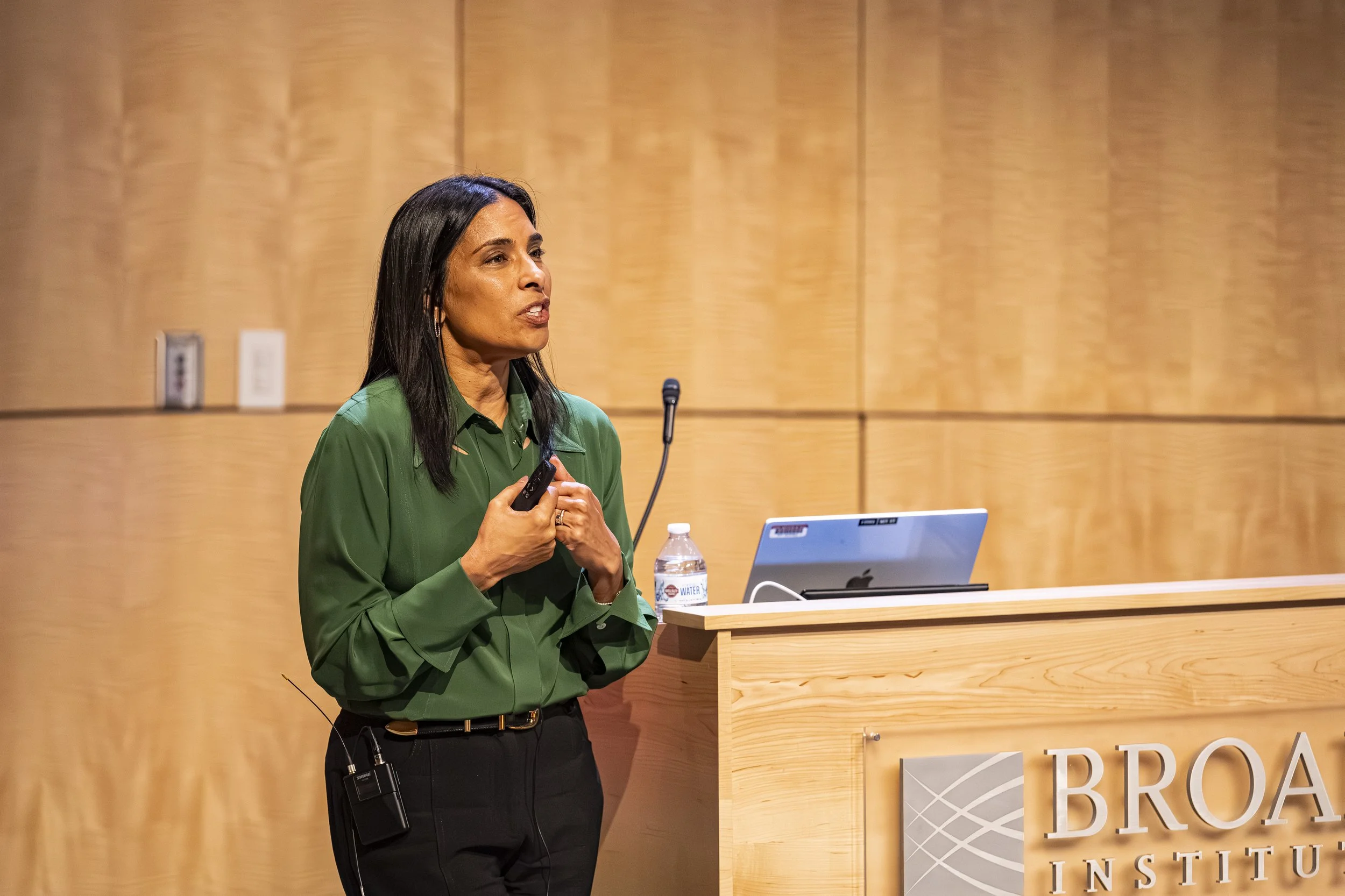
Next Marble Center seminar is on Tuesday January 20th (4-5pm) at the KI Luria Auditorium with a research talk by Dr. Susanna Elledge of the Bhatia lab.
Following the talk, we will have a hot topic presentation by Savan Patel and Daniel Kim from the Bhatia lab on integrating exposomics into nanomedicine.

SAVE THE DATE: Marble Center 10 Year Anniversary Celebration, April 9, 4:30-7pm
Please save the date for a special milestone event celebrating the 10-year anniversary of the Marble Center for Cancer Nanomedicine!
Since its founding, the Marble Center has served as a hub for nanomedicine research supporting an incredible community of innovators, seeding early-stage ideas and bridging between the fascinating worlds of biology and miniaturization to tackle grand challenges in oncology. This anniversary event will bring together faculty and industry leaders to reflect on the Center’s impact over the past decade and to look ahead to the next chapter.
News
AI-generated sensors open new paths for early cancer detection
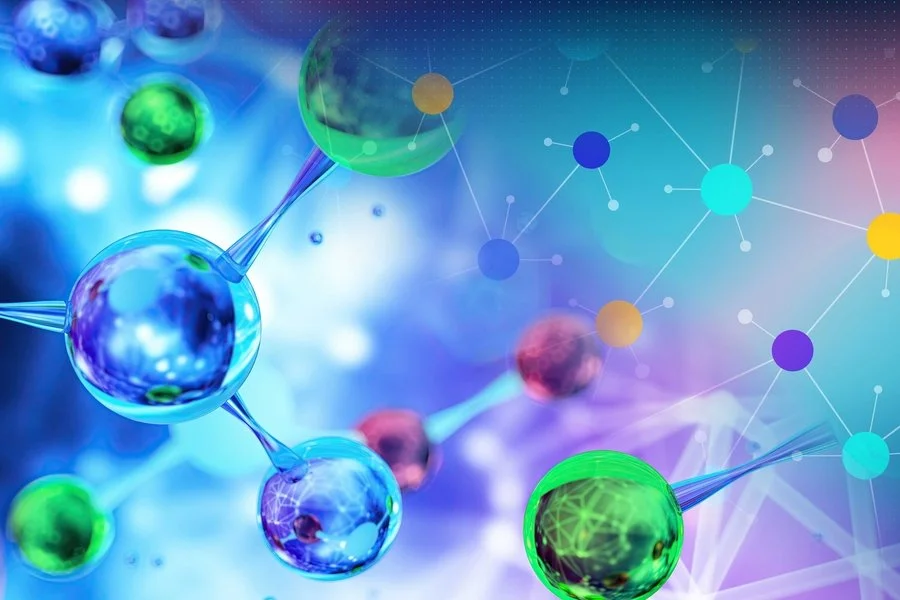
Detecting cancer in the earliest stages could dramatically reduce cancer deaths because cancers are usually easier to treat when caught early. To help achieve that goal, MIT and Microsoft researchers are using artificial intelligence to design molecular sensors for early detection. The researchers developed an AI model to design peptides (short proteins) that are targeted by enzymes called proteases, which are overactive in cancer cells. Nanoparticles coated with these peptides can act as sensors that give off a signal if cancer-linked proteases are present anywhere in the body.
Depending on which proteases are detected, doctors would be able to diagnose the particular type of cancer that is present. These signals could be detected using a simple urine test that could even be done at home. “We’re focused on ultra-sensitive detection in diseases like the early stages of cancer, when the tumor burden is small, or early on in recurrence after surgery,” says Sangeeta Bhatia, the John and Dorothy Wilson Professor of Health Sciences and Technology and of Electrical Engineering and Computer Science at MIT, and a member of MIT’s Koch Institute for Integrative Cancer Research and the Institute for Medical Engineering and Science (IMES).
Bhatia and Ava Amini ’16, a principal researcher at Microsoft Research and a former graduate student in Bhatia’s lab, are the senior authors of the study, published in Nature Communications. Carmen Martin-Alonso PhD ’23, a founding scientist at Amplifyer Bio, and Sarah Alamdari, a senior applied scientist at Microsoft Research, are the paper’s lead authors. Read more…
Pills that communicate from the stomach could improve medication adherence
In an advance that could help ensure people are taking their medication on schedule, MIT engineers have designed a pill that can report when it has been swallowed. The new reporting system, which can be incorporated into existing pill capsules, contains a biodegradable radio frequency antenna. After it sends out the signal that the pill has been consumed, most components break down in the stomach while a tiny RF chip passes out of the body through the digestive tract.
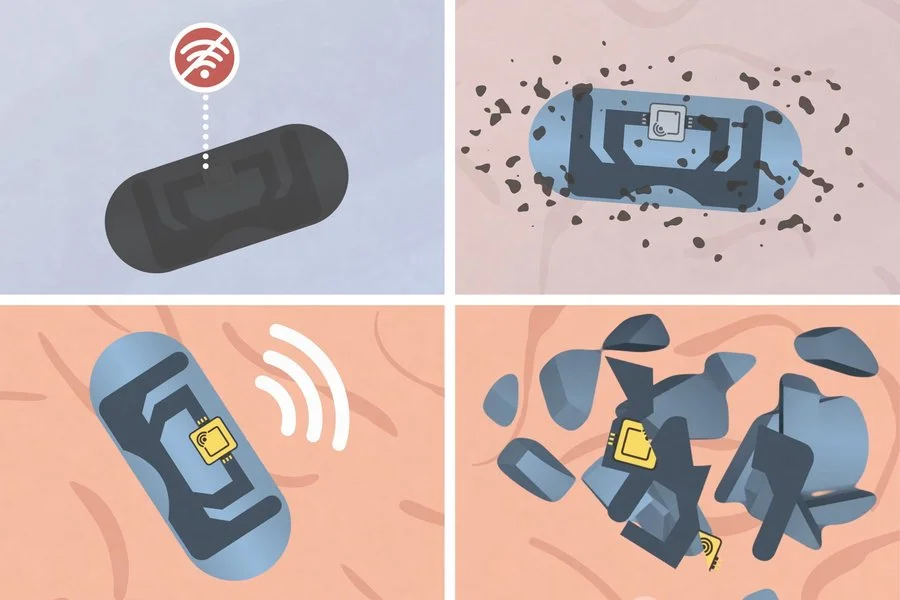
The outer layer of the capsule is made from gelatin coated with materials that block any radio frequency signal from being emitted (top left). Once the capsule is swallowed, the coating breaks down, releasing the drug along with the RF antenna (top right and bottom left). The materials are bioresorbable (bottom right). Credit: Courtesy of the researchers
This type of system could be useful for monitoring transplant patients who need to take immunosuppressive drugs, or people with infections such as HIV or TB, who need treatment for an extended period of time, the researchers say. “The goal is to make sure that this helps people receive the therapy they need to help maximize their health,” says Giovanni Traverso, an associate professor of mechanical engineering at MIT, a gastroenterologist at Brigham and Women’s Hospital, and an associate member of the Broad Institute of MIT and Harvard.
Traverso is the senior author of the new study, which appeared in Nature Communications. Mehmet Girayhan Say, an MIT research scientist, and Sean You, a former MIT postdoc, are the lead authors of the paper. Read more…
The Koch Institute's Top Research Stories of 2025
Check out the Koch Institute spotlight on some of our nanomedicine research from 2025!
Ovarian Immunotherapy Hits the Gas: Nanoparticles delivering IL‑12 with checkpoint therapy cleared metastatic ovarian tumors in mice and generated immune memory.
Antibodies make better bottlebrushes: Antibody‑guided polymer “bottlebrushes” deliver concentrated chemotherapy directly to cancer cells, eradicating most tumors in mouse models.
Machine learning helps nanoparticles make the grade: Researchers applied machine learning to design more efficient lipid nanoparticles for RNA therapies, blending AI and nanomedicine to accelerate drug delivery innovation.
Job opportunities
Assistant Professor, Biology & Biomedical Engineering, College of Arts & Sciences & College of Engineering, Boston University. Boston University’s College of Arts and Sciences, College of Engineering, and Biological Design Center (BDC) have embarked on a bold plan to improve human health by working at the intersection of tissue engineering, synthetic biology, cell biology, and mechanobiology. We have a faculty opening for a tenure-track assistant professor to join the BDC, whose faculty focus on building synthetic tissues to understand the design principles underlying biological systems. We envision a candidate whose research interests use synthetic approaches to engineer novel tissue models of disease and applied therapeutics. Areas of particular research interest include regenerative medicine, organoids, and mechano-biology. This faculty member will join a vibrant, highly successful group of researchers exploring how to guide the body to build new tissue and retool cellular machinery to optimize human health across diverse populations.
Senior Scientist, Nucleic Acid Delivery, Lila Sciences. The senior scientist will lead development of next-generation platforms for targeted delivery of nucleic acid-based therapeutics, including lipid nanoparticles and alternative gene delivery systems. The role will span developing novel chemistries, targeting strategies, and formulations; standing up high-throughput, automated screens; and building novel characterization methods that explain and predict performance. You’ll partner with chemistry, biology, automation/robotics, and AI teams and leverage both internal team and external CROs to turn design–build–test–learn into a closed loop that continuously improves therapeutics discovery, development, and delivery.
Funding opportunities
| Accelerating Innovation in Genomic Medicines LOI deadline | Jan 30, 2026 | Biswas Postdoctoral Fellowship | February 1, 2026 |