July Bulletin
Issue 118
Community Notices
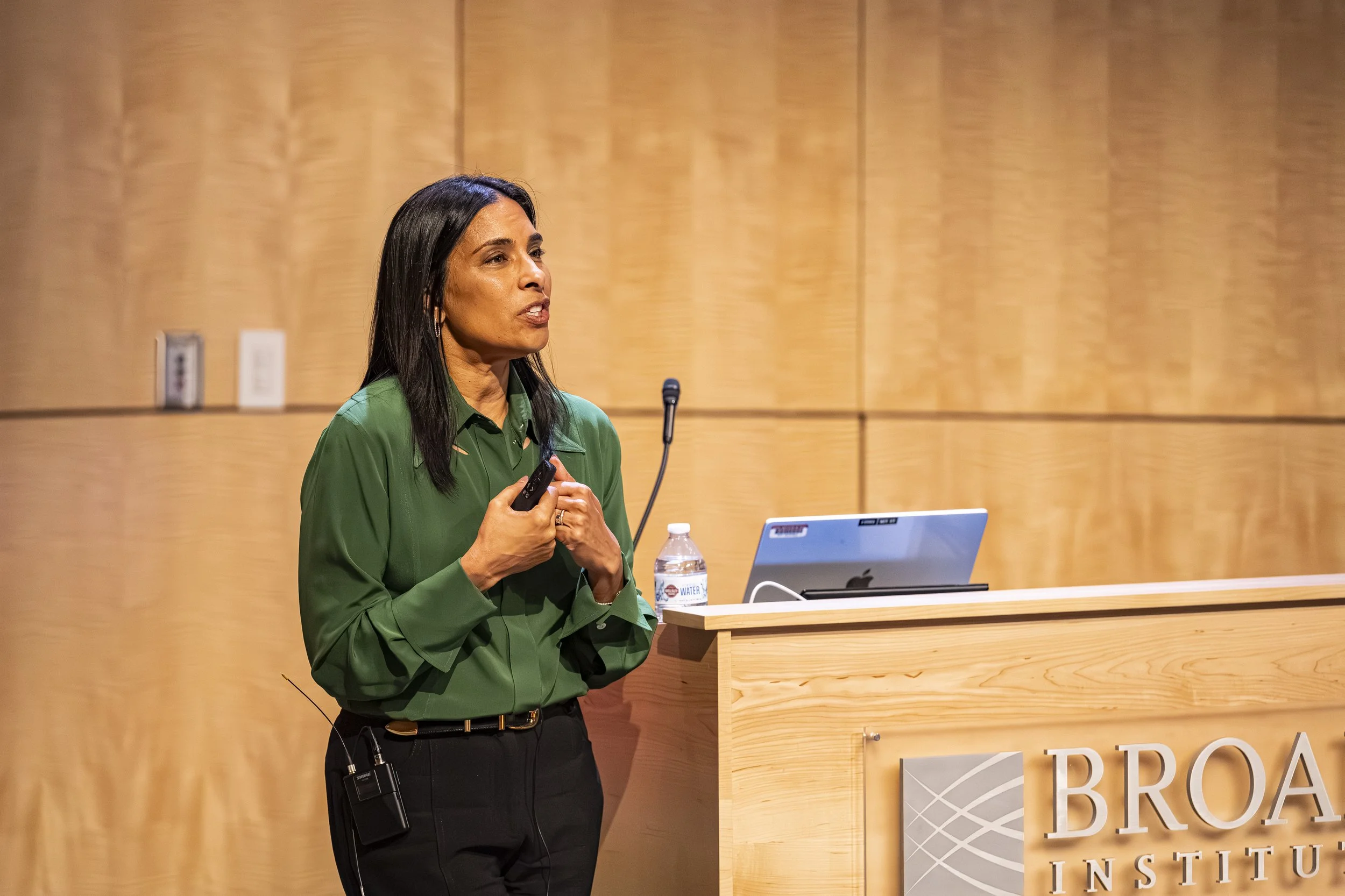
SAVE THE DATE: Marble Center Distinguished Seminar with Dr. Natalie Artzi, September 28 (4-5pm).
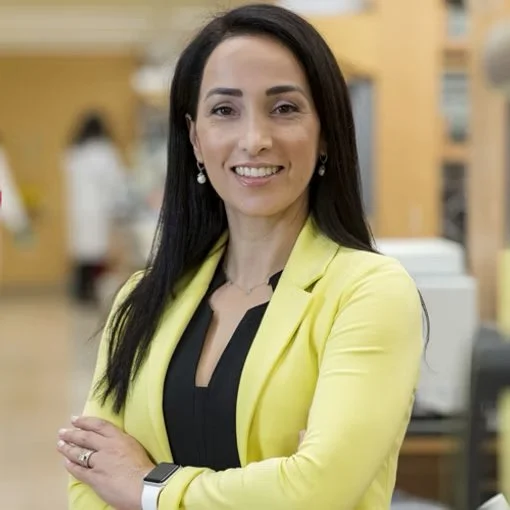
The Marble Center will host Dr. Natalie Artzi as part of our distinguished seminar series. Dr. Artzi is the Hansjӧrg Wyss Associate Professor of Biologically Inspired Engineering at Harvard Medical School, Head of Structural Nanomedicine at Mass General Brigham's Gene and Cell Therapy Institute, Associate Institute Director of the Wyss Institute for Biologically Inspired Engineering at Harvard University, and Visiting Scientist at the Institute for Medical Engineering and Science at MIT.
Dr. Artzi is a biomedical scientist-engineer renowned for transformative contributions to structural nanomedicine and pioneering work on tissue- and cell-responsive materials. Dr. Artzi developed materials that activate based on chemical cues, enabling targeted drug delivery, and creating a novel "depot effect" where nanotherapeutics are released to neighboring cells to enhance immune therapy. Read more…
Dr. Tobias Beyer, Chief Scientific Officer and lead of Business Intelligence, will be speaking about the technology. With over 20 years of research experience and a decade of R&D leadership, Tobias specializes in cell line engineering, stem cell biology, and CRISPR/Cas9. After earning his PhD at ETH Zurich and completing a postdoc at LTRI Toronto, he served as a junior group leader at ETH Zurich. Today, Tobias bridges science and business, leading cross-functional teams to develop applications for the FluidFM OMNIUM and driving innovative ideas from concept to commercial product.
Lunch & Learn seminar with Cytosurge, Thursday July 16, 2026 (noon-1pm)
Cytosurgeapplies a patented single cell bottom-up gene editing process and dynamic gene expression analysis capabilities to construct, evaluate, and debug complex synthetic mammalian cell lines. The technology, called FluidFM®, combines AFM and microfluidics to gently interact with living cells, enabling precise payload injection or cytoplasmic extraction without compromising cell viability.
Please register here — lunch will be provided (Area Four).
News
Towards controllable self-amplifying RNA
(Nature Biomedical Engineering) Self-amplifying RNA (saRNA) offers the ability to reduce the dose by between 10-fold and 100-fold compared to conventional mRNA in patients, and potentially by up to 1,000,000-fold as shown in preclinical studies, with protein expression detectable for as long as approximately 35 days, instead of approximately 10 days for mRNA saRNA is typically derived from alphaviral genomes which contain the gene sequences for four non-structural proteins (nsP1–4) that collectively constitute the RNA-dependent RNA polymerase complex, or RNA replicase.
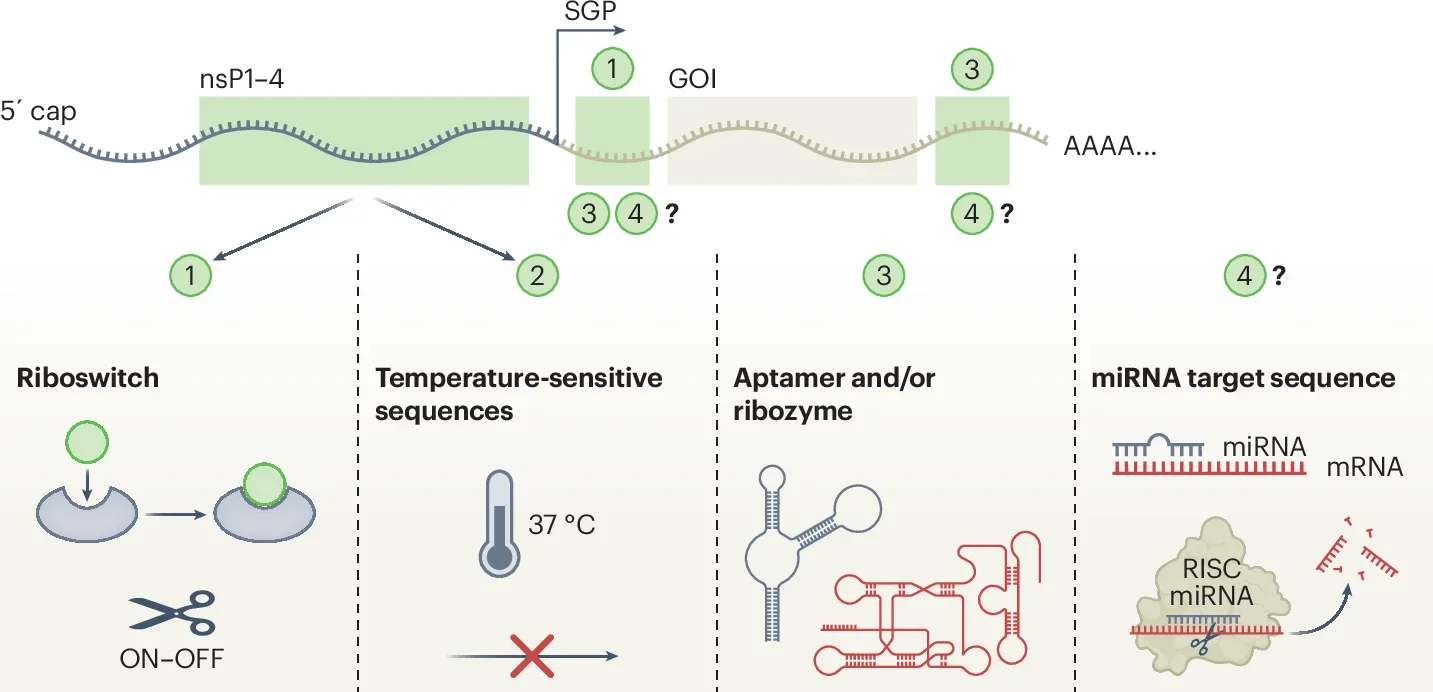
From left to right: (1) small molecule-responsive ‘ON’- and/or ‘OFF’-based riboswitches, which can be incorporated in the coding region of non-structural proteins (nsPs) or the untranslated region of the gene of interest (GOI); (2) temperature-sensitive nsP sequences can be induced by specific mutations; (3) aptamers and/or ribozymes can be included upstream or downstream of the GOI sequence; (4) the applicability of miRNA target sequences in saRNA, where tissue-specific miRNAs will guide the saRNA to the RNA-induced silencing complex (RISC) for translational inhibition or degradation, is yet to be determined, hence the question mark. SGP, subgenomic promoter.
Once delivered to the cytosol, this RNA replicase generates many subgenomic RNA copies that encode the gene of interest. Consequently, these high copy numbers facilitate substantially higher levels of, and longer-lasting, protein expression compared to conventional mRNA. This may facilitate RNA-based therapies that require less frequent administrations compared to mRNA, which would be particularly favourable for cancer treatments and protein replacement therapies. Furthermore, saRNA can be more immunostimulatory than mRNA owing to replication-derived RNA by-products that activate specific pattern recognition receptors. Therefore, the main challenges for both mRNA and saRNA are intrinsic control over immunogenicity, cytotoxicity, and magnitude, duration and tropism of expression. To control these parameters regulatory elements such as temperature-sensitive sequences, microRNA (miRNA) target sites, ribozymes, aptamers and small molecule-responsive riboswitches represent promising strategies for incorporation into saRNA backbones.
Writing in Nature Biomedical Engineering, Dr. Parisa Yousefpour (formerly Marble Center fellow at the Irvine lab, now faculty at Columbia University) and colleagues addressed this leaky background expression by developing the first saRNA sequences that incorporate trimethoprim-responsive riboswitches in the coding regions of the RNA replicase’s non-structural proteins. Read more…
Then and Now: Sangeeta Bhatia Tackles Liver Disease, Organ Transplants, and Cancer Diagnostics
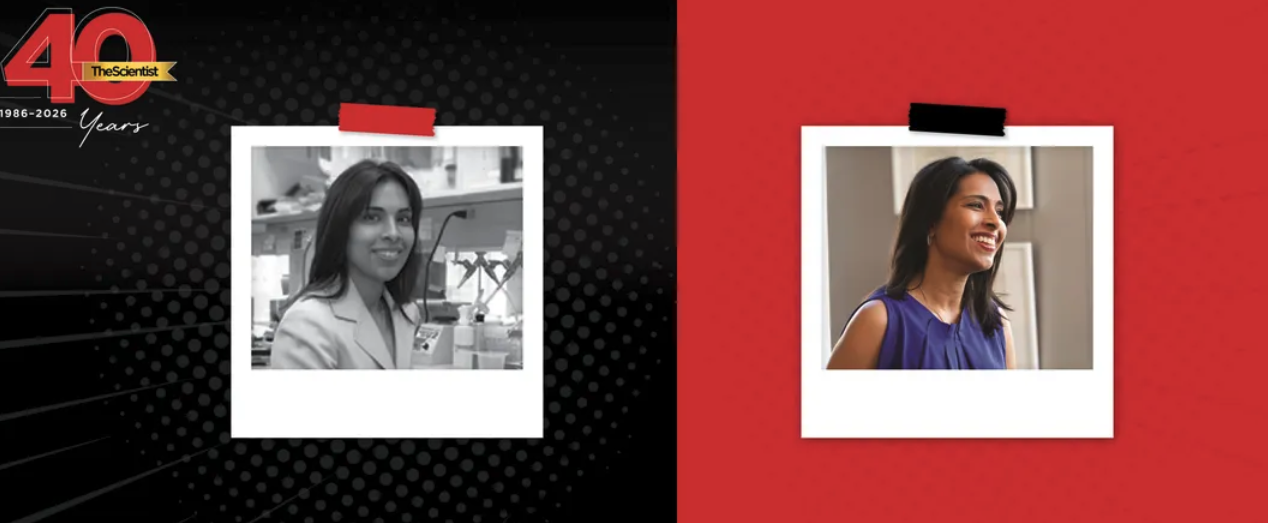
(The Scientist) Biomedical engineer Sangeeta Bhatia, of the Massachusetts Institute of Technology (MIT), had already accomplished a lot when The Scientist covered her work in 2006 and then in 2013. She had pioneered the field of biomedical microelectromechanical systems (Bio-MEMS), in which microfabrication technology is used to create devices for biomedical applications. She had also created a miniaturized liver outside the body, started a company, and launched programs to combat the high attrition rates of women in STEM—all while being a devoted mother of two. “The only question [when I was growing up] was whether I would be a doctor, an engineer, or an entrepreneur,” Bhatia said at the time. “The joke in my family now is that ultimately I ended up becoming all three.”
To celebrate The Scientist’s 40th Anniversary, we spoke with Bhatia again to see how her research has evolved over the past 13 years. Bhatia described her work in cancer and infectious disease research, her recent entrepreneurial efforts, why the liver is still the best organ, and how she measures success. Read more...
Robert Langer reveals why celebrating science can boost discovery

(Scientific American) Robert Langer is a chemical engineer and an Institute Professor at the Massachusetts Institute of Technology who specializes in materials science, biotechnology and biomedical engineering. He holds or has pending more than 1,500 patents, and he won the 1998 Lemelson-M.I.T. Prize "for being one of history's most prolific inventors in medicine."
[This interview was edited for length and clarity.]
How would you describe the current state of American science?
Overall, it's outstanding. I think there are concerns about funding and other things. For example, students that would go to certain universities in the U.S. are going overseas, you know, to Germany, China, and so forth, and I think some professors are also doing the same thing. Ultimately that is the biggest issue to me—the talent that we have at different levels and the fostering of that talent. But I still think what American science has done over the past 50, 100 years has been remarkable.
What do you think needs to change in American science right now?
There's a thing people sometimes say: a society gets what it celebrates. I think other societies sometimes celebrate science more than we do, and that affects young people deciding what careers they are going to choose. This has a lot to do with the media—people celebrate actors and actresses and sports heroes, and people aspire to become those people. I think [this is] important for science as well, and [we should make] education and science a major priority.
Job opportunities
Senior Scientist, Waters Corp. The Senior Application Scientist will lead application-driven product validation and development for light scattering technologies, ensuring performance and readiness for product launches. This role also supports customer success through technical expertise, training, and scientific content development, serving as a key link between R&D, Product Management, and customers.
Senior Scientist, Process Sciences and Innovation, Strand Therapeutics. Strand is seeking a highly motivated and innovative Scientist or Senior Scientist to join our Process Development team and lead Process Sciences & Innovation across our mRNA and lipid nanoparticle (LNP) platforms. This role is intended for an experienced lab based technical leader who thrives on solving difficult problems, challenging conventional approaches, and identifying transformative technologies that can fundamentally improve how mRNA/LNP therapeutics are developed and manufactured. The successful candidate will bring deep expertise in mRNA and LNP development, a strong understanding of emerging technologies, and a passion for translating novel ideas into practical solutions.
Funding opportunities
| Funding Source | Deadline | Marble Center INSIHT Seed Program RFP | July 24, 2026 |
|---|