April Bulletin
Issue 115
Community Notices
Register NOW: Marble Center 10 Year Anniversary Celebration, April 9 4:30pm

Just a few seats left! Join us at our 10-year celebration. The anniversary event will bring together faculty and industry leaders to reflect on the Center’s impact over the past decade and to look ahead to the next chapter.
News
New sensor sniffs out pneumonia on a patient’s breath
(Jennifer Chu | MIT News) Diagnosing some diseases could be as easy as breathing into a tube. MIT engineers have developed a test to detect disease-related compounds in a patient’s breath. The new test could provide a faster way to diagnose pneumonia and other lung conditions. Rather than sit for a chest X-ray or wait hours for a lab result, a patient may one day take a breath test and get a diagnosis within minutes. The new breath test is a portable, chip-scale sensor that traps and detects synthetic compounds, or “biomarkers,” of disease, which are initially attached to inhalable nanoparticles. The biomarkers serve as tiny tags that can only be unlocked and detached from the nanoparticle by a very particular key, such as a disease-related enzyme.
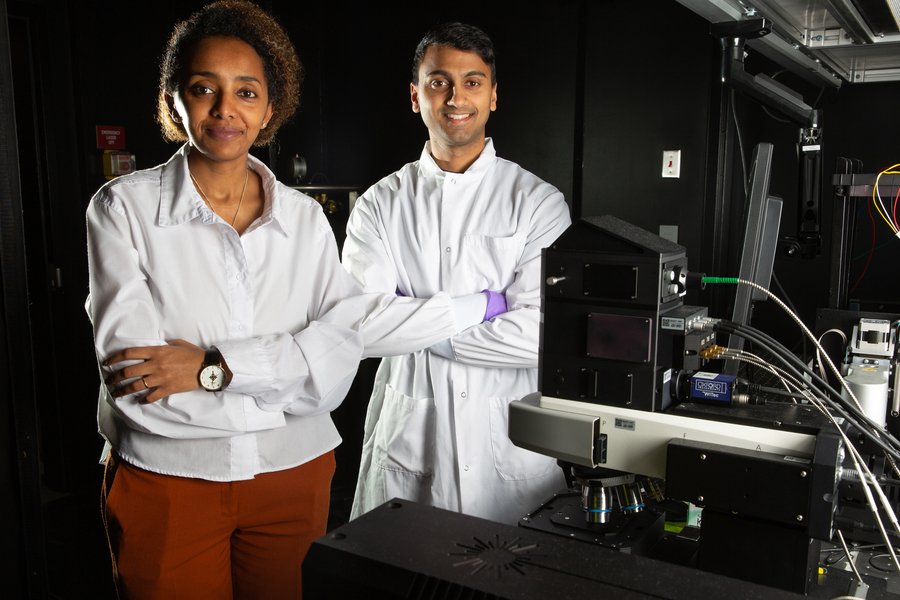
Loza Tadesse, left, and her group looked to design a sensitive, portable breath test. Tadesse and Aditya Garg stand next to the Raman microscope. Photo: Tony Pulsone
The idea is that a person would first breathe in the nanoparticles, similar to inhaling asthma medicine. If the person is healthy, the nanoparticles would eventually circulate out of the body intact. If a disease such as pneumonia is present, however, enzymes produced as a result of the infection would snip off the nanoparticles’ biomarkers. These untethered biomarkers would be exhaled and measured, confirming the presence of the disease.
Until now, detecting such exhaled biomarkers required laboratory-grade instruments that are not available in most doctor’s offices. The MIT team has now shown they can detect exhaled biomarkers of pneumonia at extremely low concentrations using the new portable, chip-scale breath test, which they’ve dubbed “PlasmoSniff.” They plan to incorporate the new sensor into a handheld instrument that could be used in clinical or at-home settings to quickly diagnose pneumonia and other diseases. “In practice, we envision that a patient would inhale nanoparticles and, within about 10 minutes, exhale a synthetic biomarker that reports on lung status,” says Aditya Garg, a postdoc in MIT’s Department of Mechanical Engineering. “Our new PlasmoSniff technology would enable detection of these exhaled biomarkers within minutes at the point of care.”
Garg is the first author of a study that details the team’s new sensor design. The study appears online in the journal Nano Letters. MIT co-authors include Marissa Morales, Aashini Shah, Daniel Kim, Ming Lei, Jia Dong, Seleem Badawy, Sahil Patel, Sangeeta Bhatia, and Loza Tadesse. Read more…
Implantable islet cells could control diabetes without insulin injections
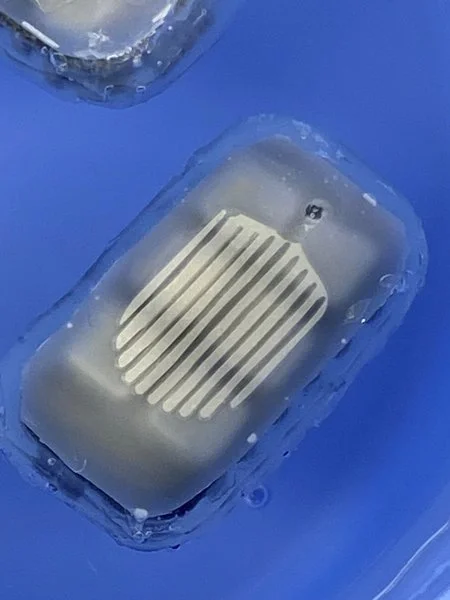
The implantable device encapsulates islet cells, protecting them from immune rejection. The device also carries an oxygen generator to keep the cells healthy. Credit: Courtesy of the researchers
(Anne Trafton | MIT News) Most diabetes patients must carefully monitor their blood sugar levels and inject insulin multiple times per day, to help keep their blood sugar from getting too high.
As a possible alternative to those injections, MIT researchers are developing an implantable device that contains insulin-producing cells. The device encapsulates the cells, protecting them from immune rejection, and it also carries an on-board oxygen generator to keep the cells healthy. This device, the researchers hope, could offer a way to achieve long-term control of type 1 diabetes. In a new study, they showed that these encapsulated pancreatic islet cells could survive in the body for at least 90 days. In mice that received the implants, the cells remained functional and produced enough insulin to control the animals’ blood sugar levels.
“Islet cell therapy can be a transformative treatment for patients. However, current methods also require immune suppression, which for some people can be really debilitating,” says Daniel Anderson, a professor in MIT’s Department of Chemical Engineering and a member of MIT’s Koch Institute for Integrative Cancer Research and Institute for Medical Engineering and Science. “Our goal is to find a way to give patients the benefit of cell therapy without the need for immune suppression.” Read more…
Job opportunities
Postdoctoral Associate - Gerstner Center for Cancer Diagnostics, Broad Institute. The Broad Institute of MIT and Harvard is seeking an outstanding Postdoctoral Associate candidate to join the Priming Agent Team—an exciting multidisciplinary and multi-lab collaboration led by Viktor Adalsteinsson (Gerstner Center for Cancer Diagnostics at Broad), Sangeeta Bhatia (MIT), and J. Christopher Love (MIT)—that seeks to unlock the power of liquid biopsies for cancer diagnostics, by addressing critical biological bottlenecks. The goal of the Priming Agent Team is to develop the first diagnostic drugs for liquid biopsies that improve the recovery of circulating tumor DNA (ctDNA) to enable early cancer detection, monitoring for minimal residual disease, and minimally-invasive tumor genotyping from blood samples (see Martin-Alonso et al Science 2024). We are seeking an exceptionally motivated individual to pursue next generation strategies involving protein engineering, nanoparticle engineering, drug delivery, and/or synthetic biology approaches, to elucidate mechanisms of ctDNA shedding and develop pharmacologically-driven approaches to enable liquid biopsy cancer detection of otherwise low ctDNA-shedding tumors.
Senior Scientist, Synthetic Enabling Technologies, Sanofi. Sanofi R&D looking for a highly motivated and collaborative individual with expertise in synthetic organic chemistry to join our Process Chemistry team. Under the direction of Process Chemistry leadership, the primary responsibility of this role is to perform and oversee multi-step route evaluation and route development activities, with the aim of establishing commercial drug substance manufacturing processes through management and execution of internal and outsourced laboratory activities. Depending on projects, this role may also oversee the activities of one or more collaborators.
Funding opportunities
| Innovative Research in Cancer Nanotechnology | May 5, 2026 | MIT HEALS Seed Grant Letter of Intent Deadline | June 1, 2026 |